
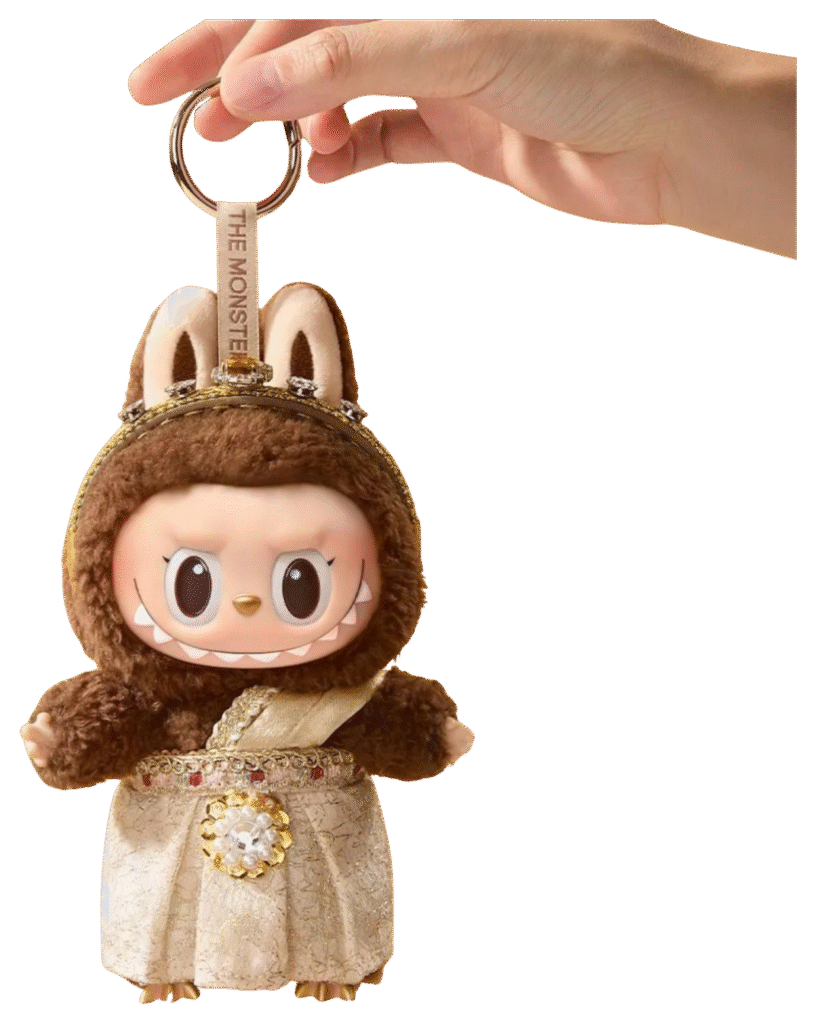
You’ve certainly heard the word “Labubu” by now, and if you haven’t, it’s not a toy for babies—well, I think it’s not. Labubu is a trend that has taken fashion girls (and guys) by the horns, and there’s a fascinating story behind how this little monster conquered the streets of New York.
The Rise of a Fashion Monster
Labubu is a monster-like character created by Hong Kong artist Kasing Lung. What started as niche art collectibles in late 2022 quickly evolved into a full-blown fashion phenomenon by 2023. The character first gained significant attention through collaborations with Asian streetwear brands and pop-up exhibitions in Hong Kong and China.
But here’s where it gets interesting: Labubu’s journey from art piece to fashion accessory mirrors the exact trajectory of how trends migrate from Asia to the West. By mid-2023, celebrities and fashion influencers began sharing Labubu collectibles on social media, transforming what was once a simple collectible into a legitimate fashion statement. High-profile sightings at fashion weeks and celebrity endorsements turned carrying a Labubu doll into the ultimate insider flex.
The Supreme Connection
I was in Asia at the beginning of the year, and just about everyone had a charm of some kind attached to their designer or thrifted bag. It was almost like buying a Balenciaga bag was easy, but making it your own with a charm or trinket was the hard part. Some were funny, some were cute, but all were deeply personal.
I noticed these little vending machines EVERYWHERE in Japan—train stations, malls, even in alleyways. They were filled with trinkets of all kinds, dispensed at random. We became obsessed with peeking into each one, seeing what was offered, choosing a favorite, and then rolling the dice, hoping we got the one we wanted. Most times we didn’t, but that only exaggerated the experience. We would try again and again.
My Accidental Deep Dive into Charm Culture
Labubu has a similar vibe to the Supreme drops that we all loved and hated at the same time. Remember picking out your favorite items from the upcoming drop and hoping you could get them into your cart first before they inevitably sold out? That’s exactly the energy Labubu captures.
Meet PopMart—imagine you rolled up to the Supreme store in Brooklyn, waited in line, and paid for an item. What item? That’s the fun; it’s always a surprise. It’s a cute way to gamble, harmless but addicting. In a PopMart vending machine, there are collections of mini trinkets across dozens of different series and collaborations.
I spent nearly our whole vacation searching for Wall-E from a Disney collaboration. I got every single character except for Wall-E. I would’ve been better off buying the whole set from the beginning, but that was all part of the fun. The psychology is brilliant—it’s the same dopamine hit as a Supreme drop, but at $15 instead of $150.
The Numbers Don’t Lie
The collectible toy market, which includes brands like PopMart (Labubu’s distributor), has exploded in recent years. PopMart’s revenue grew from $183 million in 2019 to over $600 million in 2022, according to their financial reports. The “blind box” culture—where you don’t know what you’re getting until you open it—has become a $3 billion industry in China alone.
But here’s what makes Labubu different from other collectible trends: it’s crossed over from collector culture into fashion culture. Unlike Funko Pops or other collectibles that stay on shelves, Labubu dolls are being carried as accessories, attached to luxury handbags, and integrated into daily outfits.
NYC’s Labubu Invasion
What I’m seeing in NYC right now with the Labubu craze has been a culture for a long time in Asia. Walk through SoHo, the East Village, or anywhere fashion-forward New Yorkers congregate, and you’ll spot them: small monster-like creatures dangling from designer bags, clipped to belt loops, or proudly displayed in coffee shop photos.
The trend has particularly taken hold among NYC’s fashion insiders—the same crowd that was first to embrace brands like Jacquemus mini bags or Bottega Veneta’s woven leather goods. It’s become a subtle signal: “I was paying attention to Asian fashion culture before it hit the mainstream.”
The Cultural Migration
This isn’t just about a cute character—it’s about how fashion trends migrate and evolve. What started as Japanese kawaii culture evolved through Hong Kong’s art scene, exploded in China’s consumer market, and is now being reinterpreted through New York’s fashion lens.
The charm and trinket culture I witnessed in Asia represents something deeper: personalization in an age of mass production. When everyone has access to the same designer bags and streetwear drops, the way you customize and personalize becomes the real differentiator.
Will This Trend Last?
Here’s the million-dollar question: Is Labubu here to stay, or is it just another flash-in-the-pan trend like fidget spinners or Pokemon Go?
The smart money says it has staying power, but not necessarily in its current form. The underlying trend—using small, collectible accessories to personalize and customize your look—taps into something fundamental about how we express individuality in fashion. Labubu might evolve, but the concept of charm culture is likely here to stay.
Plus, unlike purely digital trends, Labubu represents something tangible. In a world of Instagram filters and virtual everything, there’s something refreshingly real about a physical object that you can touch, collect, and display.
The Verdict
Labubu isn’t just a toy or a trend—it’s a cultural bridge. It represents the globalization of fashion in real-time, showing how a Hong Kong artist’s creation can become a New York fashion statement through the power of Asian consumer culture and social media amplification.
Whether you’re team Labubu or team “what the hell is that thing,” you can’t deny its impact on how we think about accessories, personalization, and the intersection of art and fashion. And honestly? In a world of serious fashion takes and expensive statement pieces, sometimes a little monster charm is exactly what we need.